
Thanks to the efforts of the Community Power Network, “going solar” is becoming easier than ever for communities in West Virginia.
The Community Power Network, which is currently supporting solar co-ops in Fayette and Monroe counties, began with the efforts of Washington, D.C. resident Anya Schoolman. When Schoolman’s son encouraged her adopt solar power for their home in 2007, she decided to maximize the impact of the research and effort involved by getting her whole neighborhood on board.
In the past eighteen months, Community Power Network has helped 22 neighborhoods in the District of Columbia, Maryland, Virginia, and West Virginia work together to make the installation home solar systems possible—and, more importantly, affordable—through the establishment of solar co-ops.
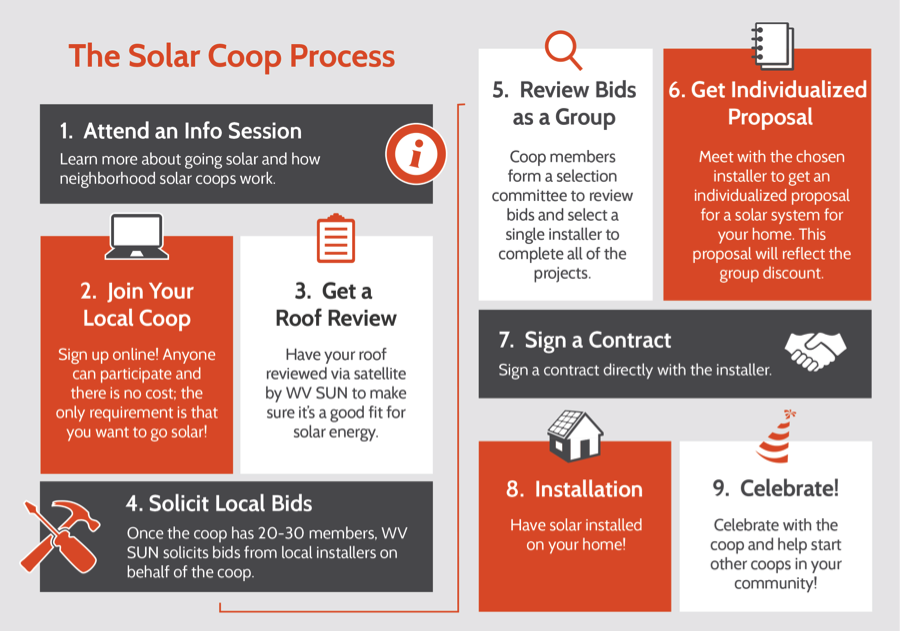
A “solar co-op” is simply a group of people in a community who decide to “go solar” as a group. Participating in a co-op allows members to cut costs, leverage strength in numbers, and lean on each other to solve issues when they arise.
Once a co-op decides to form, the DC-based Community Power Network can partner with local leaders to educate the community about solar power and provide technical assistance during the installation process. After 30 to 50 members have joined, the co-op puts out an RFP for solar installers, who then bid on the project.
In addition to cost and energy savings for co-op members, solar installation projects have generated new business in the communities they serve. The Fayette co-op resulted in so much new business for Ohio-based Appropriately Applied Technologies (AAT) that the company created a full-time position in Fayetteville to support the installation of the project. They have also hired local electricians and contractors to help with the work.
What’s the real return on investment in a solar installation? According to the Community Power Network, an average home solar system costs between $8,000 and $15,000. The solar energy produced in a year might be worth $500 to $600, but since electric rates have been rising, the same amount of power might be worth $1,000 five years from now. Over the long term, the cumulative savings could be five to six times the initial investment in a solar system.
West Virginia also offers incentives like net-metering, which reduces the electric bills of solar homes by the amount of kilowatt-hours they produce. A 30% federal tax write-off can also be applied to the cost of installing solar panels. There are also savings involved in going solar with neighbors: the Monroe County co-op, for instance, will save 20-30% of the cost of their systems through a bulk discount.
The Fayette and Monroe co-ops are excellent examples of what’s possible when West Virginians work together to support the adoption of innovative technologies for the benefit of their communities.
To date, there are 96 members in the Monroe Co-op and 36 in the Fayette Co-op. Membership in both organizations is free. The Community Power Network is looking to form new partnerships with communities who are interested in starting their own solar co-ops. For more information, contact Emily Stiever.
