
By Corey Zinn · Edited by Rebecca Kimmons
Startup of the World’s Favorite Community Jam
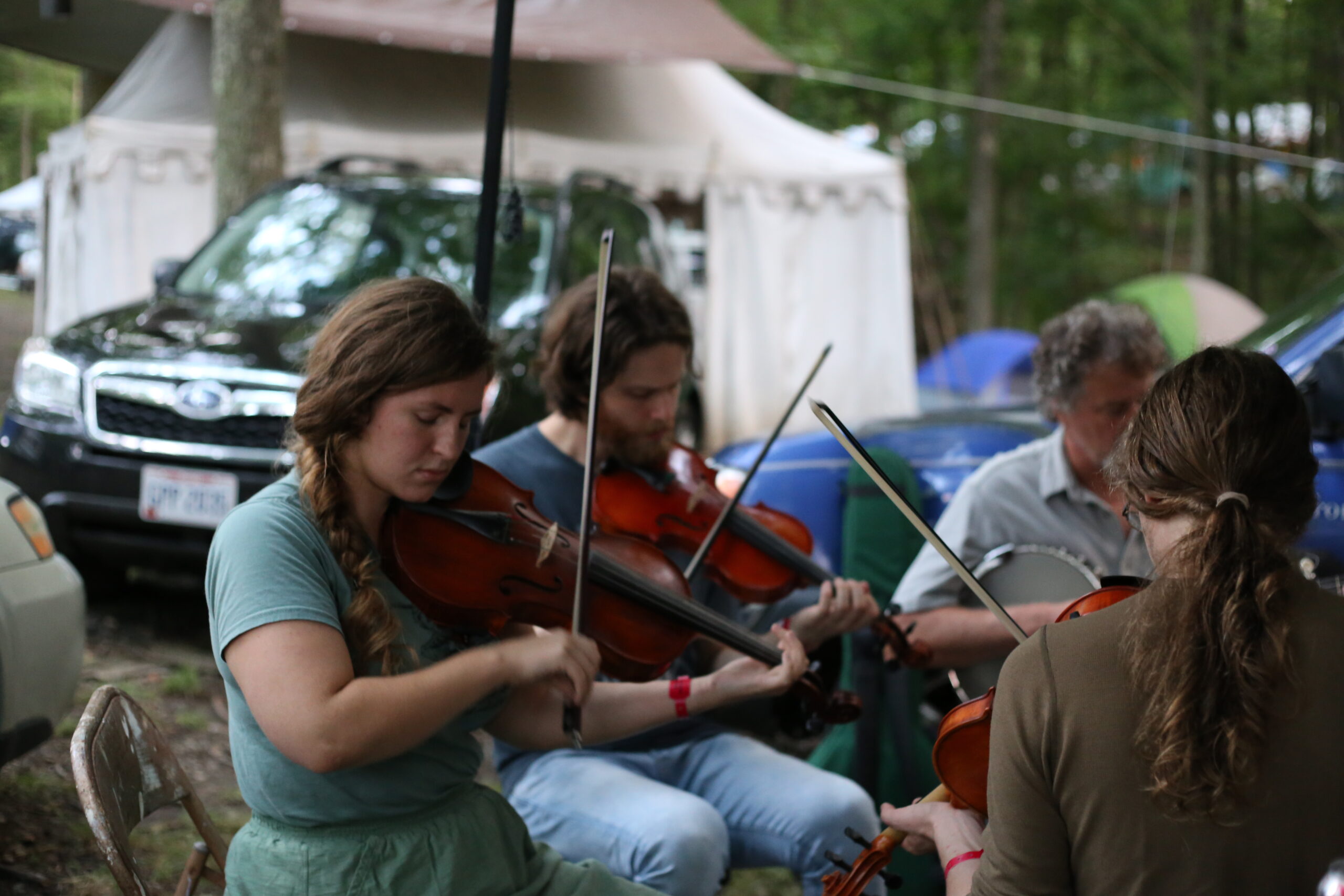
Climbing Cool Mountain Road through the Appalachian forest toward Camp Washington-Carver, you hear music floating on the summer breeze. By the time you’ve paid your forty-five bucks for an unlimited pass at the gate, you’re surrounded, immersed in lilting sound. More than three thousand musicians are playing fiddles, banjos, guitars, big upright basses, at campsites, under trees, on the roads, in the woods, and on the porches of a gigantic chestnut log building.

Daniel Erwin, an entrepreneurial engineer from Arkansas, takes a break from singing, accompanying himself on a mandolin. “Here, it’s different from other festivals. It’s ninety percent pickers, ten percent spectators. And if you can’t play, you can cook.”
No one comes for staged concerts at the Appalachian String Band Music Festival. Not at Clifftop. “These are the stages right here. It happens under these canopies.” The Arkansas traveler invited me to share some bear meat at his neighbors’ buffet, in traditional Clifftop fashion.

It’s more than a musical tailgate. People come year after year from all over the world. They claim their usual spots and start jamming; many as much as a whole week before the official festivities begin. During those ten days, it isn’t Camp Washington-Carver at Clifftop, West Virginia. It’s Clifftopia.
Will Carter, a Charleston, West Virginia native, created the festival in 1989 when he was working as an assistant to Governor Gaston Caperton, who saw an important place for arts in economic development. A double-bass player himself, Carter had been to similar festivals such as the Old Fiddler’s Convention in Galax, Virginia, and the Mt. Airy Fiddler’s Convention in North Carolina. When he attended the Appalachian Open Bluegrass contest at Camp Washington-Carver, he saw the camp could be perfect for an old-time music gathering. Key infrastructure was already in place.

“Bill Drennen, then the new commissioner of Culture and History, was open to new ideas. And there was a supportive and entrepreneurial director of Camp Carver at that time whose name was George Jordan,” Carter recalls. “George understood events and logistics and customer service. Bobby Taylor knew how to do a contest. I had a sense of what would build community, so the three of us put our heads together. My contribution was creating the Neo-Traditional band contest. I did that to explicitly indicate that this festival was open to innovation and extensions of the string band tradition into non-traditional formats and context and voices.
“So the festival embraced the idea of evolving folk music. A few people think of folk music as something to be being preserved on a shelf,” Carter says, “and God bless ‘em, we have a lot of preserved music because of that, but frankly, the guys they preserve on that shelf, who said, ‘this is the old-time way,’ they learned it from somebody else who played it slightly differently. The music always changes. The preservationists are valuable, but I wanted to have an equal acknowledgment of people who were taking the music in new directions. Right off the bat, we signaled that this was not just another Mt Airy or Galax.

We always intended to keep the context of traditional Appalachian music, but the Non-Traditional Band Competition was created to offer extensions of the music. If you want to play an Indian sub-continent sitar for your thing, fine, we love it, it’s lots of fun, but it’s not going to get the judges’ highest marks. But if you come in with a sitar and play an old-time tune that has Appalachian rhythms, then you could get high scores. We eventually changed the name of that competition to Neo-Trad Band, and it has brought in new generations of musicians. It’s just more inclusive, and since my primary motivation was community building, it seemed like the sensible thing to do.” The Neo-Trad contest ensures that innovation will be rewarded, not stifled.

Now, nearly thirty years later at Clifftop, you’ll find pockets of Celtic, bluegrass, swing, Cajun, old country, jazz and blues, all joyously coexisting, unamplified, within the old-time community. As long as you speak harmony, you’re cool. Attendees have come from twenty countries and 48 states. Children have grown up with the festival, returning year after year, waving hello to their annual neighbors.
Over the years, neighborhoods have emerged. The young folks gather in the bottom where the music goes nonstop. If you want sleep after, say, one or two a.m., you head up to the water tower. The bluegrassers congregate on the flats outside the gate in their RVs and pickups. The Cajuns set up way down on the edge of the woods where all the night owls flock.

The various communities come together around one big stage, to see their friends compete for prize money that names champion fiddlers, banjoists, dancers, and bands. The competition is fierce but friendly. Many consider them the world championships.

From the get-go, Carter directed with a light hand. Before the very first event, the groundskeeper was chalking out campsites. Carter stopped him, saying to only chalk out places where campers couldn’t go. “That will be chaos!” the groundskeeper objected, but Carter insisted that people would figure it out on their own. After the first day, the groundskeeper had to admit, ‘It’s working great.’ And on that first final Sunday, after everyone had left, he couldn’t believe how clean the place was. The people policed themselves. It’s partly the crowd, and partly the design.

For the initial event, Carter called it a “gathering,” and strategically invited seven great bands from different corners of the nation. They scheduled it the weekend before Galax in hopes of catching some of that event’s attendees. And they didn’t skimp on the prize money for the five competition categories. Carefully chosen judges who are well respected for their expertise today distribute nearly $7,000 to winners.
Clifftop’s long-running success bears out Carter’s belief that traditions thrive as long as they are open to change. There will always be a thrill in linking arms in a dance circle, spinning at a dizzying rate. Singing in harmony with the crickets in the forest, dancing in the dirt under the starry sky, sharing food and age-old tunes from camp to camp—that’s Clifftop, an idyll, a midsummer night’s dream.

Written for the Maker’s Guide to Opportunity. About the Appalachian String Band Music Festival at Clifftop, WV, and its founder, Will Carter.