
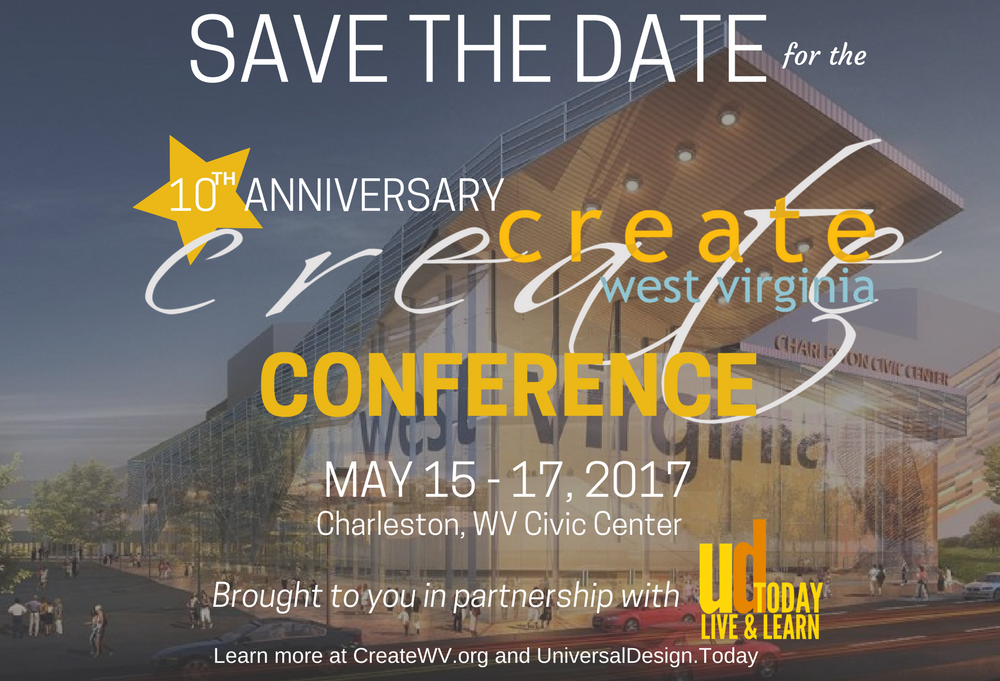
Many of you have been asking, when and where is the next Create West Virginia Conference?
Create West Virginia will celebrate its 10th anniversary by co-sponsoring a national innovation-economy based design conference centered on housing, community development, education, technology and business. The Universal Design Today: Live & Learn Conference is coming up May 15-16-17, 2017 at the Charleston Civic Center, in our capitol city, Charleston.
Why the laser focus on Universal Design?
Because 21st century life calls for a fresh design approach–for everything we use—products, services, buildings—for living and learning. We can design just about everything to attract what we want more of. If we want to attract innovators, entrepreneurs, families, tourists, retirees and investors, then make a place for them, complete with all they want and need.
Businesses and communities, indeed entire states are competing to attract talent, residents and 21st century investment. Major metropolitan areas are attractive to many, for many reasons. If smaller communities are to attract the talent and investment necessary, across generations, it will be by design–and the devil will be in the details, for sure.
This conference offers participants diverse perspectives tailored to, but not limited to, medium and small urban and rural populations. Participants will have access to a variety of experts, including USDA researchers, world-class design, building and planning professionals, in addition to local and regional practitioners, entrepreneurs, educators and advocates. The conference will help others design attractive, functional, user-friendly places, products, programs and services that will appeal to and be used by a greater number of people with a range of abilities. The Universal Design Today conference is a terrific fit with Create West Virginia’s annual training conference efforts–we’ve always supported the push for WV communities to create authentic, beautiful, affordable, convenient places in which diverse abilities and talents live, learn and thrive. Together we can learn how and work to design living and learning spaces, programs and products that are compelling and sustainable, making the best use of our natural, human and built assets–while showcasing our vision and intent for a new, equitable and prosperous future. Our people and places deserve the best design thinking and problem solving now and for the future as we grapple with population and workforce shifts. The 2017 conference asks the question:
HOW DO WE (RE)CREATE BUILDINGS, COMMUNITIES, LEARNING PLACES, PROGRAMS AND PRODUCTS FOR 21st CENTURY PEOPLE?
The gold standard for design is Universal Design, often referred to as UD. It’s time for UD to take center stage.
Renowned 20th century inventor and visionary Buckminster Fuller said, “We are called to be architects of the future, not its victims.” As rural and urban people across the nation prepare to face some of the most serious societal issues in human history, i.e. an aging population, lack of adequate housing, skyrocketing housing and energy costs, lack of jobs, skyrocketing medical expenses, poor public health, lack of equitable access to transportation, education, jobs, food and infrastructure–just to name a few, how we “design” what we all use becomes critical to our quality of place, life and learning. Make no mistake about it–good design is good business, and good design makes people happy. Happy people tend to be healthier, more productive people–and that’s what we all want more of, right? It’s high time we all learn the seven Universal Design principles and guidelines, and immediately begin applying them to improve everything we use to live and learn.
Maybe you’re still thinking that this focus on design is not your jam. Maybe you don’t see the significance of designing everything to be ultra user-friendly and aesthetically attractive for every generation and ability. Let’s quickly define Universal Design and give some examples of its practical application.
WHAT IS UD? “Universal Design, adapted from a definition by the late Ron Mace, is the design of products and environments to be usable by all people, to the greatest extent possible, without the need for specialized design.” – Richard Duncan, Executive Director, RL Mace Universal Design Institute.
LET’S TAKE IT HOME Now think about your house or apartment. How user friendly is your home? As you age, are you looking forward to moving to an assisted living center, or would you, like 91% of others polled, prefer to age safely in your home for as long as possible? Do you have to walk up steps to get in? How user-friendly are your bathrooms for all the people in your house, including visitors? And how about your kitchen and closets? Is the design of your home, or parts of it, limiting you or others? Are you unhappy with the look of accessibility upgrades like ramps and funky grab bars? We know you realize that it costs a lot more to retrofit a home to fit your changing needs, and what you end up with isn’t always good for the resale value of your home. Wouldn’t it have been terrific if your home had been built from the beginning to anticipate your changing needs and desire to be independent, and active–for a lifetime? Did you know that West Virginia law requires builders to hand you a list of UD features to consider before you build? Most people express surprise when we tell them that for more than seven years, West Virginia builders have been legally required to inform and consult with homeowners regarding UD options. What are those options? Ask a builder, or plan to come to this conference! (And bring your favorite builder!)
WHAT ABOUT THE CLASSROOM?
As science and research sheds light on how we all learn in an increasingly complex world, new insights on methods, technology, physical environment and cognitive development offer educators, parents and students new tools, hope and support systems for learning success. Imagine classrooms and curricula designed from the beginning to support the diverse abilities of all learners–to facilitate education that defies the myth of “average.”
AND WHAT ABOUT COMMUNITIES?
Perhaps for the first time in history, generations can agree on what they want in their community. Millennials, Boomers and even the Silent Generation are looking for well-designed, right-sized, affordable and beautiful homes that work for the current and future needs. They want to live in well-considered, efficient, attractive, and walkable communities with terrific access to modern transportation, healthy (delicious/diverse) food, green space, and other life-improving amenities and services. What does your ideal community look like? Is it designed for maximum beauty, enjoyment, convenience, and public health? Is it one for which you need a car? Is there access to fresh, healthy food and medical services, schools, and business districts? Is it one that is designed to work for you and your family along your continuum of life? With so many rural communities needing critical infrastructure upgrades, housing and commercial building rehabilitation, many places are in just the right spot to push the “Do Over” button. When communities are small enough, they can get stakeholders together to design for an extraordinary living experience–one that attracts investment, supports the well-being and livelihood of its citizens, encourages engagement, independence and happiness.
LET’S TALK TECHNOLOGY, GADGETS AND APPS Universal Design is applicable to websites and other technologies, community planning, public art, wayfinding, transportation, neighborhoods, healthcare facilities, restaurants, retail stores, coffee shops, and more. But the most well-known example of UD principles at work may just be your cell phone. Many people can’t imagine life without their smart phone, and many people never bothered to read the instructions that came with their phones. When the design is good, there’s little need for directions. You see, Steve Jobs insisted that designers design for the widest range of abilities–he insisted that design be human-centered, intuitive, super user-friendly, and yes, beautiful. Apple changed the way we all interact with our phones when it introduced the sleek, beautiful, intuitive iPhone that features a variety of accessibility features that most people now take for granted, like Siri. Universal Design leads to the best design of places and products for everyone, of all abilities. In an increasingly tech-driven world, the opportunities for tech entrepreneurship are vast. Following UD principles from the beginning will ensure the broadest market appeal and usability. We’re inviting makers of new technologies to get their products in front of people during this conference.
PLACEMAKING…FOR THE LOVE OF PLACE AND PEOPLE The Universal Design Today: Live & Learn Conference will be a grand celebration of ten years of Create West Virginia’s work toward cultivating the five pillars of Innovation Economy throughout our state’s communities. This conference touches on all the elements of these five pillars: diversity, education, entrepreneurship, quality of place, and technology. It will also mark the beginning of a national collaboration that aims to take Universal Design principles to Main Street, and to every classroom, and to the design benches of every developer, designer or tinkerer.
This will be the ultimate Quality of Place conference, showcasing design-driven housing and community development best practices, as well as entrepreneurship, education, and technology innovation brought to bear on the creation of places, programs and products that work for you–and a great diversity of people and abilities, without special accommodations.
THE PROMISE If West Virginia communities and businesses, educators, builders and designers enthusiastically adopt and apply Universal Design principles, we can place ourselves in the forefront of communities where innovators, families, and job creators will want to live, work and contribute. We’ll all be able to brag about living in an authentic, very hip, intentionally designed, smart and age-friendly West Virginia—and safely invite others to join us here, knowing our community will keep the promise.
WHO SHOULD PLAN TO ATTEND, PRESENT, AND NETWORK?
You. Yes, even if going to conferences isn’t your thing, or you think you already know plenty. Plan to join experts in Universal Design from all over the nation—architects, engineers, educators, designers and entrepreneurs–who will converge in Charleston’s newly renovated Civic Center to share their knowledge of best principles for creating places and products for everybody. The City of Charleston will become a living lab for design projects and public space hacks, to demonstrate what can be done here and now, and in similar places around the world, to improve how we live, learn and work.
The national CALL FOR PRESENTATIONS is HERE.
The invitation to EXHIBIT AND SPONSOR is HERE. Conference organizers reserve the right to curate vendor and design displays.
WHO’S ORGANIZING THIS SHINDIG? Our partners are PATHS (Partnerships in Assistive Technologies), RL Mace Universal Design Institute, CAST (Center for Applied Special Technology), WVU’s Center for Excellence in Disabilities and the Northeast Regional Center for Rural Development located at Penn State University.
#CreateWVConference2017 #UniversalDesign #MainStreet #communityplanning #regionalplanners #education #placemaking